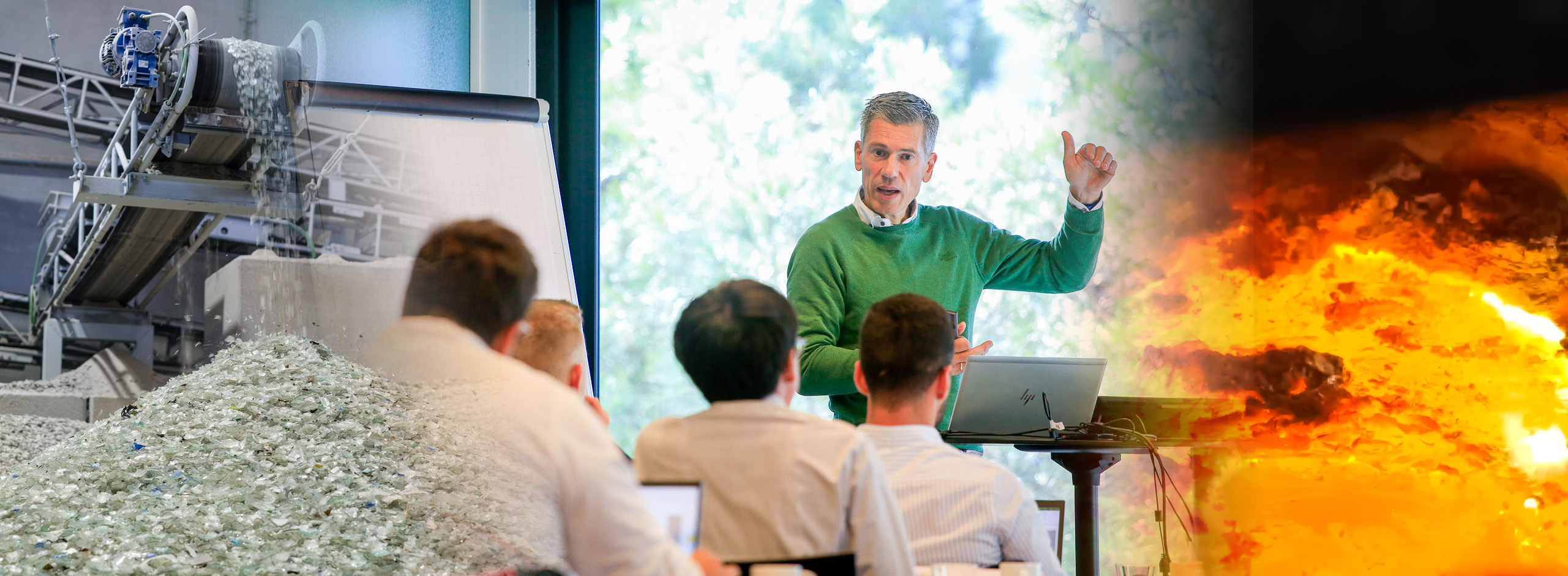
The General Glass Technology Training is an intensive one-week program that combines theory and hands-on experience to provide a comprehensive understanding of glassmaking, balancing both its scientific and practical aspects. Participants gain insight into raw materials, furnace operation, redox control, defect reduction, and batch-to-melt processes, while also exploring key topics such as sustainability, energy efficiency, emissions reduction, and future melting technologies. Designed for both newcomers and experienced professionals, the training equips attendees with the knowledge and skills to optimize glass quality, improve process efficiency, and address real-world production challenges, all while building valuable connections within an international network of glass industry experts. Based on CelSian's renowned Glass Technology Handbook and decades of industrial expertise, this course bridges fundamental glass science with practical manufacturing applications.
Attend if you are interested in:
- Glass composition and glass chemistry
- Raw materials and batch formulation
- Glass melting and fining processes
- Furnace operation and heat transfer
- Redox control and color management
- Glass defects and troubleshooting
- Process control and production optimization
- Energy efficiency and sustainability
- Emission reduction strategies
- Future glass melting technologies
- Practical problem-solving in industrial glass production
What you take away:
- Explain the fundamental principles of industrial glass production, from raw materials to finished glass.
- Evaluate the impact of raw material selection on glass chemistry, product properties, and melting behaviour.
- Understand furnace operation, heat transfer mechanisms, and key melting phenomena.
- Identify and address redox-related issues affecting fining, foaming, heat transfer, and glass colour.
- Analyze common glass defects and implement corrective actions to improve product quality.
- Apply process control principles to optimize manufacturing efficiency and consistency.
- Assess opportunities for energy savings, emissions reduction, and more sustainable glass production.
- Compare conventional and emerging melting technologies and understand their role in the future of the glass industry.
- Translate theoretical concepts into practical solutions for day-to-day production challenges.
-
Build confidence in communicating technical glassmaking concepts across operational, technical, and management teams.
Your trainers

Scott Cooper
Scott holds a PhD in Material Science and Engineering. After graduation, he began as a scientist at O-I, the world’s largest manufacturer of glass containers. His work at O-I focused on novel approaches to melting and manufacturing glass, for which he earned 13 US patents. From May 1st, 2023, Scott Cooper has taken on the role of Technical Director for the USA at CelSian.

Katelyn Kirchner
Katelyn Kirchner obtained a Ph.D. in Materials Science and Engineering from the Pennsylvania State University, USA. She holds 2 collegiate-level Teaching Certifications and is a certified online and in-person professor. In addition to her 4 years of experience teaching, Katelyn brings 8 years of experience investigating structure-property-performance relationships in glass. Her expertise centers around glass structure, statistical mechanics of glass forming, and the physics of critical atomic glass behaviors, including glass viscosity, relaxation, crystallization, crack propagation, and heat transfer. Katelyn has worked in industrial and academic research groups in Japan, Germany, and the USA. She now studies glass melting at the manufacturing scale, as a Glass Process Scientist at CelSian.

Jeff Watts
Jeff attended the Ohio State University, majoring in ceramic engineering. Worked in PPG Industries as a production engineer. At Anchor Hocking, he researched raw materials to improve glass quality and reduce costs. Spent 18 years at O-I, starting as a senior global furnace operations engineer. He was promoted to global furnace operations leader. In this role, he led an international team and oversaw the development and implementation of a global standard for furnace operations. In 2024, he joined CelSian as operations project leader.

Cristian Hernández
Cristian Hernández graduated as a Materials Engineer from the University of Antioquia, Colombia. Then he obtained a Master’s degree in Metallurgical and Materials Science at the University of Sao Paulo, Brazil. He worked for 8 years as a Glass Science engineer at OI for different plants in South America, supporting them in color changes, glass quality issues, furnace and batch house ramp-ups, raw materials standardization and implementation of new ones. He joined Celsian as a Project leader acting as a supporter and technical advisor.

Eric Muskovin
Eric Muskovin studied glass and ceramics at the University of Missouri of Science and Technology (Rolla). He graduated with a BS in Ceramic Engineering and a MS in Material Science and Engineering in 2018. Eric has worked in both manufacturing as a Batch & Furnace Engineer, and in R&D as a Glass Scientist. Utilizing knowledge in both glass manufacturing and R&D, Eric looks to bridge the gap of conceptual ideas and real-world experiences.
Training costs $2975 - per participant
Price excludes tax and duties.